How to Be a Christian by C. S. Lewis
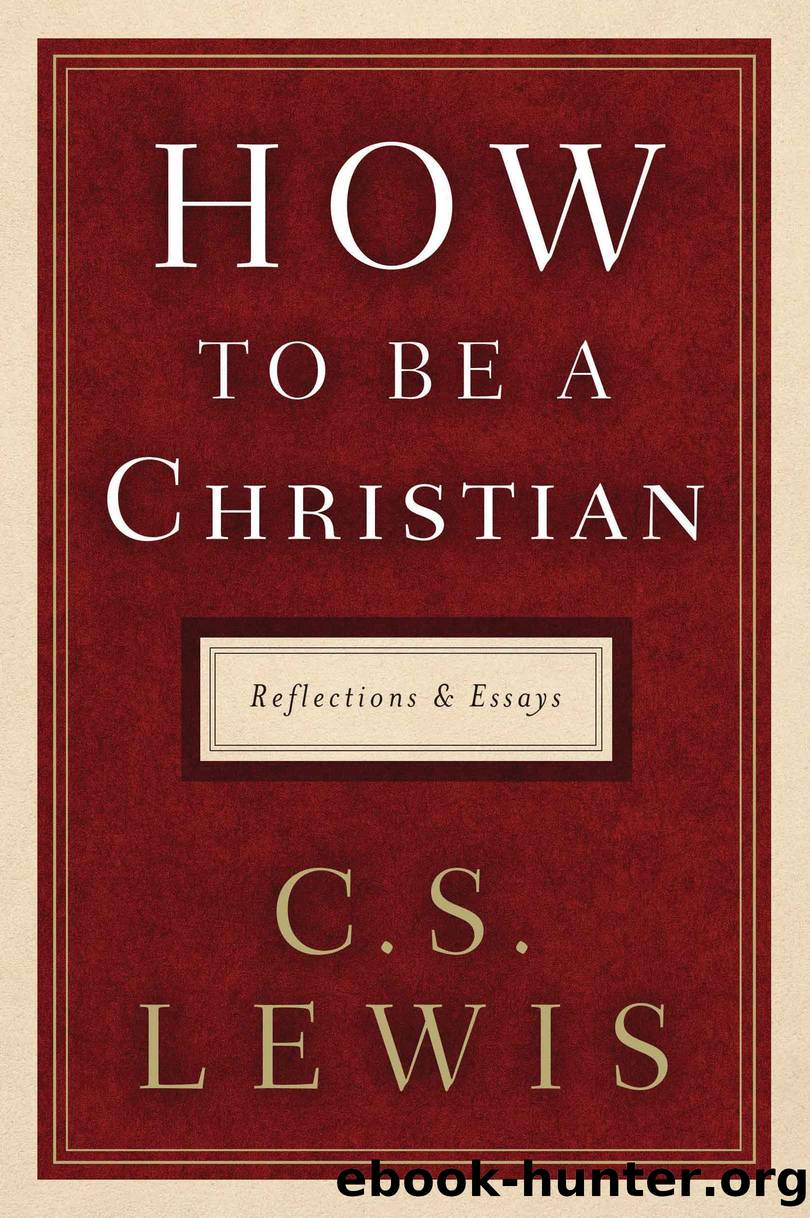
Author:C. S. Lewis
Language: eng
Format: epub
Publisher: HarperCollins
Published: 2018-06-08T00:00:00+00:00
On Not Feeling Threatened When Christianity Remains Unchanged While Science and Knowledge Progresses
* * *
God in the Dock, from the chapter titled âDogma and the Universe.â
WHEREVER THERE IS real progress in knowledge, there is some knowledge that is not superseded. Indeed, the very possibility of progress demands that there should be an unchanging element. New bottles for new wine, by all means: but not new palates, throats, and stomachs, or it would not be, for us, âwineâ at all. I take it we should all agree to find this sort of unchanging element in the simple rules of mathematics. I would add to these the primary principles of morality. And I would also add the fundamental doctrines of Christianity. To put it in rather more technical language, I claim that the positive historical statements made by Christianity have the power, elsewhere found chiefly in formal principles, of receiving, without intrinsic change, the increasing complexity of meaning which increasing knowledge puts into them.
For example, it may be true (though I donât for a moment suppose it is) that when the Nicene Creed said âHe came down from Heavenâ, the writers had in mind a local movement from a local heaven to the surface of the earthâlike a parachute descent. Others since may have dismissed the idea of a spatial heaven altogether. But neither the significance nor the credibility of what is asserted seems to be in the least affected by the change. On either view, the thing is miraculous: on either view, the mental images which attend the act of belief are inessential. When an uneducated convert and a Harley Street specialist both affirm that Christ rose from the dead, there is, no doubt, a very great difference between their thoughts. To one, the simple picture of a dead body getting up is sufficient; the other may think of a whole series of biochemical and even physical processes beginning to work backwards. The doctor knows that, in his experience, they never have worked backwards; but the uneducated convert knows that dead bodies donât get up and walk. Both are faced with miracle, and both know it. If both think miracle impossible, the only difference is that the doctor will expound the impossibility in much greater detail, will give an elaborate gloss on the simple statement that dead men donât walk about. If both believe, all the doctor says will merely analyze and explicate the words âHe rose.â When the author of Genesis says that God made man in His own image, he may have pictured a vaguely corporeal God making man as a child makes a figure out of plasticine. A modern Christian philosopher may think of a process lasting from the first creation of matter to the final appearance on this planet of an organism fit to receive spiritual as well as biological life. But both mean essentially the same thing. Both are denying the same thingâthe doctrine that matter by some blind power inherent in itself has produced spirituality.
Does
Download
This site does not store any files on its server. We only index and link to content provided by other sites. Please contact the content providers to delete copyright contents if any and email us, we'll remove relevant links or contents immediately.
How to Be a Christian by C. S. Lewis(969)
The Gentle Breeze of Jesus by Mel Tari(752)
Shadow Work Journal for Self-Love by Latha Jay & Valerie Inez(477)
Mind Hacking for Rebels by Karin Tydén(403)
Transactions we Expose by Chelsea Michelle & A.M. Heath & Amanda Tero(399)
You are the Way: Manifest your Dream Life with Neville Goddard Law of Assumption - Best Manifesting Books about Manifestation | Book for Women Men Teens ... on Love Health and Money | Kindle eBook by unknow(395)
Practical Ways To A Powerful Personality by Unknown(389)
O's Little Guide to Finding Your True Purpose by O The Oprah Magazine(386)
The Triple Path by James Kenneth Rogers(364)
My Cosmic Quest: A Search for Enlightenment: Revealing the Mystery of Karma, Reincarnation, and the Purpose of UFOs in Our Skies by Gavan Paul(364)
How to Become a People Magnet: 62 Simple Strategies to Build Powerful Relationships and Positively Impact the Lives of Everyone You Get in Touch with by Marc Reklau(358)
O's Little Book of Love & Friendship by O The Oprah Magazine(336)
Unconditional Life by Deepak Chopra M.D(334)
Block Pass by Bonnie R. Paulson(332)
Passport Mindset A Guide to Manifesting Your Ideal Life by Valentino Erik(324)
The Power of Hex by Shawn Engel(323)
21 Hacks to Rock Your Midlife by Cat Coluccio(314)
Journaling Basics by Lisa Shea(311)
Brand Archetypes Guide by Unknown(309)
